
Effectiveness Comes from Developing Both Leadership and Management Skills
Effective engineering leaders are both managers and leaders and know how to move fluidly between both.

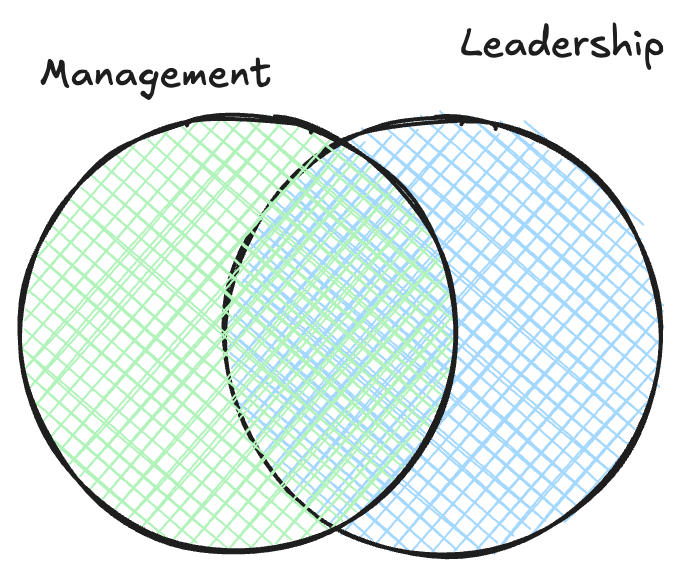
If you ask a room full of people whether they would rather be a leader or a manager, you’ve already biased the results. If I was in that room, I would probably raise my hand for leader too.
When we think of leaders, we think of extraordinary people we have a lot of respect and positive emotions towards.
“Leaders” sound impressive and they are. They inspire people, create movements, and challenge the status quo.
In engineering organizations, they might stand in front of whiteboards drawing bold visions of the future while everyone nods in admiration.
Managers, on the other hand, are often portrayed as people who schedule meetings, update spreadsheets, and ask uncomfortable questions about deadlines.
The former sounds like a visionary and the latter sounds like someone asking whether you’ve updated Jira.
Unsurprisingly, most of us want to be leaders. Very few grow up saying, “One day, I hope to become excellent at resource allocation.” Or should I say “a manager”?
This perception is understandable. Most of us can easily recall examples of inspiring leaders who influenced us. Fewer can point to examples of exceptional managers. When management is done poorly, it often feels bureaucratic, controlling, or disconnected from the work itself.
Over time, this has created a false impression that leadership is inherently more valuable than management.
The reality is more complicated.
Organizations do not succeed because of leadership alone, nor do they succeed because of management alone. They succeed when both skills are developed and are present and working together.
Imagine an engineering organization embarking on a major platform shift. It could be a big migration or a rewrite.
Someone must help the organization understand why the change matters. Someone must set the direction and show others the way. That person might create alignment around a shared vision of the future. They might influence people to move beyond the comfort of the current state. That is leadership at play.
But someone must also determine priorities, allocate resources, coordinate dependencies, manage risks, and ensure that work is executed effectively. This person might even spot an inefficient process and optimize it. This is management at play.
Engineering managers deal with people, and dealing with people requires an ability to influence them (leading).
You will also have to make do with finite resources (capacity, time, budget, servers, or GPUs, whatever they’re called these days) to achieve your set goals. Dealing with finite resources requires an ability to make effective use of them (managing).
Both activities are different and sometimes overlap but serve the same purpose. I like to think of it as leadership creating movement and management turning that movement into results.
Leadership without management creates vision without execution. Teams understand where they are going but struggle to get there.
Management without leadership creates execution without direction. Teams become efficient at delivering work that may not ultimately matter or move them towards the mission.
To be an effective engineering leader, you have to understand that leadership skills and management skills are complementary rather than competing. You’ll need to hone your intuition to recognize when a situation requires leadership and when it requires management. More importantly, you have to develop skills in both.
This distinction is particularly important because leadership and management are often misunderstood as roles rather than skills.
You’re a leader; you just don’t know it yet.
Many people assume leadership begins with authority. That is not true.
One of my favourite authors wrote something in his book that almost felt like blasphemy:
“Leaders are angry people.” He then proceeded to say leadership is born when someone is dissatisfied with a situation and determined to pay the price to change the status quo.
Leadership begins when someone recognizes that the current state can be improved and takes the initiative to do something about it.
Think about a time when you initiated a positive change in your own life, helped a family member overcome a challenge, or guided a colleague toward a better outcome.
In each of these situations, you influenced movement from one state to another. That is leadership skills.
The scale may be small, but the underlying skills and intent is the same.
An engineer who identifies recurring operational failures and proposes a more reliable architecture demonstrates leadership.
A staff engineer who aligns multiple teams around a shared platform initiative demonstrates leadership.
A junior engineer who introduces a better way of working and earns the trust of teammates demonstrates leadership.
You’re a leader just like any other leader. What is different is the context, scale, and level of complexity at which you’re exercising your leadership skills.
In each case, someone is helping others move from the current state toward a better future state.
Leadership is less about authority and more about influence. No formal title is required to lead.
This is why some of the most important acts of leadership in engineering organizations come from people who manage no one. Engineers who mentor colleagues, improve team practices, create shared tools, or influence technical direction are exercising leadership regardless of title.
Management, however, addresses a different challenge.
You’re a manager; you just don’t know it yet.
If leadership helps determine where a group should go, management helps ensure it gets there.
Management is the discipline of organizing resources to achieve desired outcomes. Those resources include people, time, budget, attention, tools, information, and organizational capacity.
When I worked at a small company, I thought about how I wished I worked in a bigger company with a bigger budget and infinite resources at my disposal. I joined a much bigger company and learned that resources are finite everywhere.
Because resources are always limited, management is fundamentally about making choices. Prioritization decisions, staffing decisions, and trade-offs between cost and speed are all about making choices and managing finite resources efficiently.
In engineering organizations, management shows up in planning, staffing, performance management, career development, budgeting, risk management, and cross-functional coordination.
These responsibilities may not appear as exciting as defining a vision, but they are equally important.
A brilliant strategy without execution rarely succeeds. Likewise, a motivated team without coordination will eventually lose momentum.
Like leadership, management exists at every level. And you’re already a manager; you just don’t know it yet.
When you prioritize competing tasks, estimate effort, organize a project, or coordinate work with others, you are exercising management skills.
Managing yourself requires managing your time, energy, and attention. Managing a project requires coordinating tasks and resources. Managing a team requires balancing priorities across multiple people.
Managing an organization requires optimizing resources across entire departments and functions.
The scale at which you manage, the level of complexity, and the blast radius are different, but the underlying capability remains the same: organizing limited resources to achieve desired outcomes efficiently.
You’re more effective when you develop both management and leadership skills.
For engineering managers, the conclusion is straightforward. You do not need to choose between becoming a leader and becoming a manager.
Leadership helps people understand where they are going and why it matters. Management creates the conditions that allow them to get there.
The best engineering managers develop both capabilities and learn to move fluidly between them. They create direction when direction is needed. They create structure when structure is needed.
They help teams move toward a better future while ensuring that future becomes reality.
Great framing! I agree that you need a balance of innovation and execution.
Leadership isn't tied to a title.
Pleased to include this post in this week's TIE digest!
You have a rare gift for making complexity feel both clear and alive. If you want a system to move well, you need both the vision that changes direction and the discipline that keeps the whole thing from drifting apart. "Management is doing things right; leadership is doing the right things." (Peter Drucker I believe).